
Let me ask you something.
When was the last time you Googled a business before you called them? Now — when was the last time you asked AI the same question?
If you’re like most people I talk to, the second one is happening more and more. You type something like “what’s the best way to find a therapist for my teenager” or “what should I look for in a business coach” into ChatGPT or Google’s AI Overview, and you get an answer. A real answer. Not a list of ten blue links you have to sort through. An actual answer that sounds like it came from someone who knows what they’re talking about.
Here’s what I need you to sit with for a second: that answer came from somewhere. It came from someone’s content. Someone’s website. Someone’s expertise — or at least the appearance of it.
The question I want you to ask yourself today is: Is it yours?
The Source Attribution Gap
There is a specific kind of invisibility that is new to the internet, and most business owners have not yet been introduced to it.
Here is what it looks like:
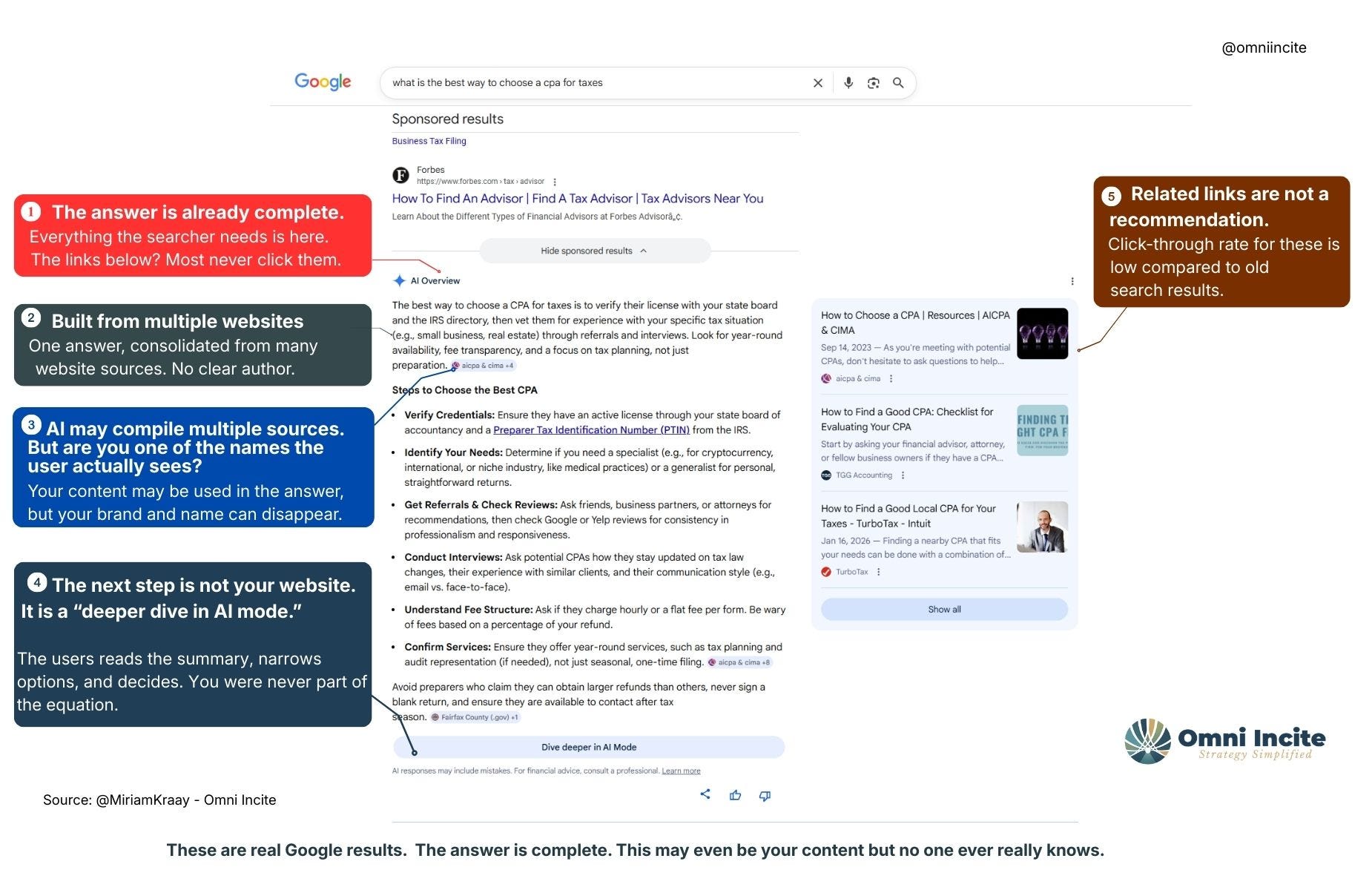
A potential client asks ChatGPT or Google a question. The AI reads your website, pulls from your content, combines your expertise alongside three other sources — and delivers a confident, useful answer. The person gets what they needed and moves on.
No click. No visit. No lead.
You provided the value. You did not get the credit. And no notification that any of it occurred.
Zero-Click Search
Zero-click search is not coming. It is already happening. Many of the people who would have found you before AI summaries launched are now reading the summaries instead, which means fewer link clicks and decreased website visits. Pew measured behavior directly and found that when an AI summary appears people click a traditional result about half as often (8% vs. 15%). That’s the zero-click problem in plain terms.
What changed is not just where people click. The bigger shift is that the user no longer needs to visit your site or your competitor’s to do due diligence and make a decision. It all happens right there: they read the summary, narrow their options, and decide, and you were never part of the equation.
The Rules Changed. Most businesses don’t Know Yet
For two decades, SEO operated like a filing system. Put the right words in the right places often enough, and the algorithm would find you and sort you into the right drawer. It was mechanical. It was gameable. It rewarded volume over substance — and the internet filled up accordingly.
The new system does not work that way. AI search acts like a compression layer. It condenses a noisy internet into a usable answer; unfortunately, not everything survives that compression equally.
AI search is not driven by keyword counts alone. It is evaluating credibility. It asks whether your content reflects genuine expertise or competent imitation. It looks for depth, specificity, and original perspective. The things that signal a real practitioner, not a content calendar.
The businesses that win in AI search are not the ones with the most content. They are the ones whose content is genuinely worth quoting.
What “Being Cited by AI” Actually Requires
At Omni Incite, I call this credit visibility—the difference between being the source and being the ghost. AI can use your expertise to answer the question and never say your name. You influenced the decision. You just didn’t get the client.
This is the real shift: your content can be read, blended, and delivered inside the answer while your brand and your name can disappear. Businesses that get cited by AI tend to share three characteristics:
First: specificity over fluff. Not “we provide compassionate, individualized care.” Not “I help you become the best version of yourself.” Not “I empower you to become your best self.” AI ignores them for the same reason your clients do—they don’t actually say anything. They don’t tell a reader what problem you solve, how you solve it, or what changes.
The content that gets cited names the problem precisely, explains the process honestly, and respects the reader’s intelligence.
Second: Your perspective over generic. AI can generate an adequate summary of what most people in your field believe. What it cannot generate — and therefore values highly — is what you specifically think, based on your actual experience. The counterintuitive observation. The thing your clients are afraid to ask out loud. The pattern you have seen repeat across a decade of cases. That is the content that becomes a citation source.
Third: A body of work, not a backlog of posts. One article does not establish authority. Twelve articles that circle the same core problem from different angles, answering different questions, connecting different situations, tell AI what you are actually the expert on. Reputation is built the same way online as it is everywhere else: through consistent, recognizable presence over time.
From Ghost Source to Cited Authority
The goal of content has changed. It is no longer to earn the click. It is to become the source — the voice AI trusts enough to quote when your potential client is asking the exact question you know how to answer.
That is a different kind of authority than SEO ever required. And it is harder to fake.
The businesses that understand this early will not just perform better in search. They will become the reference point that shapes how their industry is understood by AI, and by the people AI is answering.
The ones who do not will keep writing content that gets read by machines, used without credit, and handed to leads who will never know they exist.
If you’re not being cited, you’re not in the decision.
If this landed, subscribe. More is coming. The full framework lives at omniincite.com
Miriam Kraay is the founder of Omni Incite, a strategic marketing consultancy helping founders and business owners build authority that AI search can find, quote, and trust.